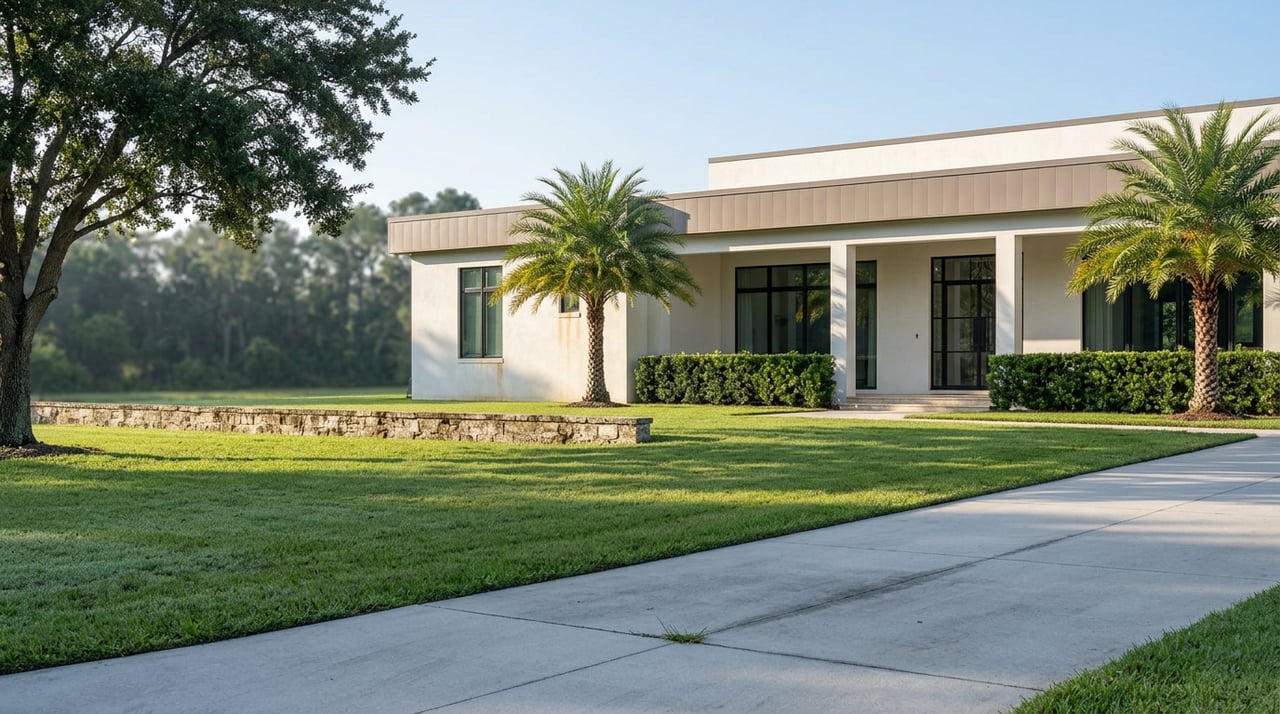
Why BBB Ranches Acreage Doesn't Compare Directly With the Rest of Parkland
Pull up two listings inside BBB Ranches on the same afternoon and you can end up looking at roughly 2.3 acres on one street and three acres half a mile away that share almost nothing beyond similar acreage. One might be raw land with a canal on one side and nothing built on it yet. The other might carry a resort-style pool, a cold plunge, and a home that once showed up in a national commercial. Neither price reflects the acreage alone.
Most of Parkland doesn't work this way. Inside a gated community with an HOA, a builder floor plan, and a matched utility hookup for every lot, price per square foot is a reasonably honest sorting tool. Buyers scanning Parkland as a whole often carry that assumption into BBB Ranches, the roughly one-to-twelve-acre, non-HOA enclave off Holmberg Road that locals just call the Ranches. It doesn't hold up here, and the reason isn't mysterious once you know where to look. Zoning, not square footage, helps determine what a given acre is worth.
BBB Ranches isn't a subdivision that got built on land the city already controlled. It's closer to the reverse. The tract is tied to the original parcel that formed the City of Parkland, and the city marked its 63rd anniversary in March 2026, which places incorporation in 1963, the same era this land entered the record. Home construction on the Ranches itself didn't really begin until the 1970s and has continued in waves since, which is why you'll find a 1970s ranch house on three acres sitting a few hundred feet from a home finished in the last two years.
That timeline matters for a practical reason. Newer Parkland communities like Heron Bay or Parkland Golf & Country Club were platted, zoned, and utility-served as complete packages before the first house went up. The Ranches was carved out lot by lot over five decades, under an agricultural zoning designation that never required uniform infrastructure. Every parcel inherited whatever water, septic, and access arrangement existed when it was created, and those arrangements remain different from lot to lot.
Parkland's own code of ordinances carries a section most home shoppers never open: an AE-2 Agricultural Estates division alongside a separate Parkland Equestrian District classification. Together they cover the handful of tracts in the city, including the Ranches and a smaller pocket called Country Acres, that carry an A-1 Agricultural-Residential designation rather than the standard residential zoning that governs Parkland's gated communities. That single line on a zoning map is the reason BBB Ranches has no HOA, why lots run from roughly one acre up to twelve, and why the district remains one of the only agricultural-zoned residential tracts left in Broward County at all.
The code also sets a floor most buyers don't discover until they're deep into due diligence. That doesn't erase the smaller legacy lots already on record, some under an acre, platted long before that minimum applied. Subdivision potential can have a significant effect on land value, beyond what is visible from the street.
Here's where the comparisons really fall apart. Because the Ranches grew one parcel at a time, utility service was never rolled out evenly. Some streets run on municipal water. Others still depend on private wells, and on properties that keep horses or maintain ponds, a well is often doing double duty for irrigation and livestock. Septic systems are common enough that a buyer coming from a city-served gated community needs to budget time for a septic inspection most Parkland transactions never require.
None of this shows up in a headline price or an acreage figure. It shows up in the disclosure package, the appraisal, and often in the loan underwriting, since some lenders price well-and-septic properties differently than municipally served ones. A recent property tax and insurance shift already reshaped how Parkland sellers need to prepare before listing, and a Ranches property adds its own layer on top: buyers should confirm water source and septic permit status before they ever get to the inspection period, not during it.
Look at three recent examples from current Ranches inventory and the pattern is obvious:
| Acreage | What Came With It | What's Actually Driving the Price |
|---|---|---|
| Roughly 2.3 acres | A waterfront lot inside a small subdivision called Parkland Magic, no structures on site | Raw land value alone, no utility or improvement premium |
| Roughly 3 acres | A fenced compound with municipal city water, a 6-foot perimeter fence, an electric gate, and an 8,000-plus square foot home | City water and security infrastructure layered on top of the base land |
| Roughly 3 acres | A resort-style pool, waterfalls, a cold plunge, and an 11,700-plus square foot home previously featured in national commercials | Finish level and prior media exposure, independent of the acreage itself |
The acreage is similar across all three. The number tells you almost nothing about what you're paying for until you know which of those layers is stacked on top of it.
If a BBB Ranches listing says "no HOA," don't read it as "fewer costs." Fencing, drainage, and road maintenance on private easements may still add costs.
Land listings inside the Ranches frequently advertise subdivision potential or proximity to Parkland's Equestrian Center as a selling point for buyers who want horses on site. Some current listings even carry a specific caution in the fine print: any development plan, and any assumption about keeping horses, is subject to the buyer independently verifying current zoning and municipal permitting. Setback requirements, easements, and prior variances differ lot to lot, the same way utility service does.
Agricultural zoning alone does not establish that a specific horse use is allowed on a parcel. Before submitting an offer on any Ranches parcel, it's worth confirming, in this order:
That last point deserves its own note. Agricultural zoning can open the door to a lower assessed value under Florida's agricultural classification, but eligibility depends on demonstrated agricultural use and is reviewed by the Broward County Property Appraiser, not assumed from the zoning code alone. It's worth confirming directly with that office rather than treating it as automatic.
Vacant land listed across Parkland this month runs close to $1.6 million an acre on average, a number that includes everything from small infill parcels to acreage sitting inside districts like the Ranches. That average is a reasonable starting point for the raw land itself. It says nothing about what gets built on top of it, and inside BBB Ranches specifically, the gap between two parcels of identical size can come down entirely to water source, septic condition, subdivision eligibility, and whatever improvements a prior owner added.
For a buyer moving out of a gated Parkland community and into the Ranches, that trade is real: less HOA oversight and far more land, in exchange for infrastructure that isn't standardized and due diligence that runs longer than a typical suburban closing. For a buyer moving the other direction, the reverse is true. Understanding which side of that trade you're actually making, before an offer goes in rather than during inspection, is the difference between a Ranches purchase that goes smoothly and one that stalls at the septic report.
Is BBB Ranches gated? No. It's a non-HOA district, and while individual homeowners often add their own gates and fencing, there is no community-wide gate or association governing the neighborhood as a whole.
Can any lot in BBB Ranches keep horses? Individual lots still need to be checked against current setback rules, easements, and any prior variances before assuming horses are cleared for a specific parcel.
Does BBB Ranches have an HOA fee? No. The absence of an HOA is one of the defining features of the district, though buyers should still budget for private road, drainage, and fencing maintenance that an HOA would otherwise coordinate.
If you're weighing a move into BBB Ranches, a standard Parkland gated community, or anywhere in between, the acreage number on a listing is the beginning of the conversation, not the end of it. Roman Pavlik has been sorting through Parkland's zoning lines, utility maps, and comps since 1999. Start with What's My Parkland Home Worth? or reach out directly before you write an offer on a parcel whose value depends on more than acreage alone.
This article is general information, not legal, tax or financial advice. Consult a qualified professional about your situation.
I bring decades of luxury real estate mastery, guiding clients through high-end transactions with precision and discretion. With a proven track record of $87M+ in closed sales and expertise in properties up to $10M, I deliver results-driven, personalized service. Partnering with me means access to exclusive opportunities and elite market insight tailored to your goals.
Roman Pavlik
Roman’s Address 8064 NW 124th Ter Parkland FL 33076